“There is a very interesting self-filling holy water stoup at the ruined church of Llanidan in Anglesey…There is no visible means of ingress for the water. Yet (if no tourist has been there before you) you will always find the stoup filled with water”.
Edmund Vale, 1940
The first stop off on our virtual tour of curiosities, inspired by Edmund Vale’s book, ‘The Curiosities of Town and Countryside’ is St Nidan’s holy water stoup, which reportedly never runs dry despite no obvious source of replenishment. Incredibly, it turns out that this watery wonder is only the second most curious curiosity linked to the Anglesey church.
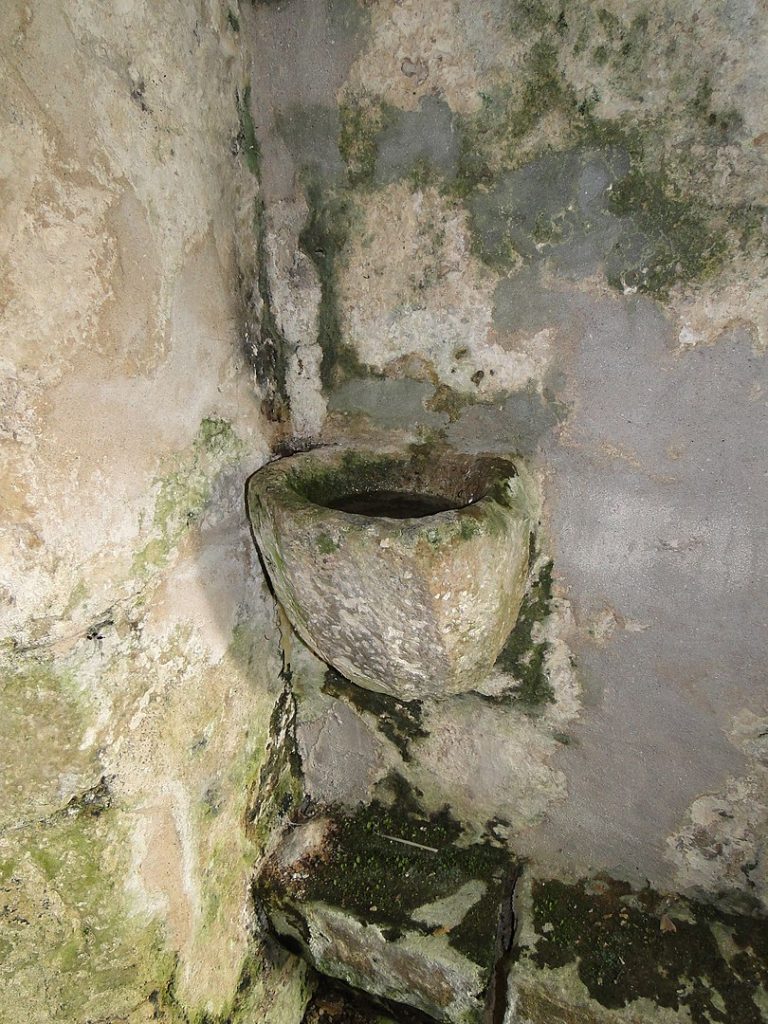
By Bencherlite – Own work, CC BY-SA 3.0, https://commons.wikimedia.org/w/index.php?curid=17078032
In the twelfth century, Gerald of Wales wrote of a stone that looked like a thigh bone which always returned to the church, no matter how far away it was taken. He reported that a Norman Earl of Chester had tested out the legend by chaining the ‘Maen Morddwyd’ to a boulder and chucking it in the sea but by the following morning it was back at the church. I swear that I am not pulling your leg. I cannot however vouch for the veracity of Gerald of Wales.
In a somewhat unholy water twist, the stone was said to sweat when a couple committed a lustful act near it, which somewhat surprisingly Gerald suggested happened often. There seems to be some disagreement amongst sources on t’internet as to whether the rock aided or impeded reproduction. A sweaty stone does seems a highly unreliable form of contraception but I suppose it beats wearing weasel testicles around your neck.
At some point in history, the thigh was tethered to the church wall, possibly as a way of stopping it wandering, possibly as a way of deterring couples from copulating alongside it. William Salisbury recorded seeing it there in 1554 but when a group of Cambrian archaeologists had a lovely time meeting, in Bangor in 1860, they reported that it was fixed in a wall at Porthamel, around a mile away from Llanidan. However, following their visit, the alliterative Rev W Wynn Williams suggested it was no longer to be found there. Maybe the Thigh Stone walked back to St Nidan’s, which handily brings us to the point of this project.
The ruins of St Nidan’s are now in private ownership but open to the public from time to time. Have you visited? Does the water stoup survive and is so, is it still full of holy H20? And if you did happen to spot a stone in the shape of a femur? Well, that would just be a bone-us.
Sources
The Archaeological Journal Vol 26 1869
The National Gazetteer of Great Britain and Ireland – 1868
Leave a Reply